The Green Table Northumberland brings organisations together in Berwick
19th May 2026
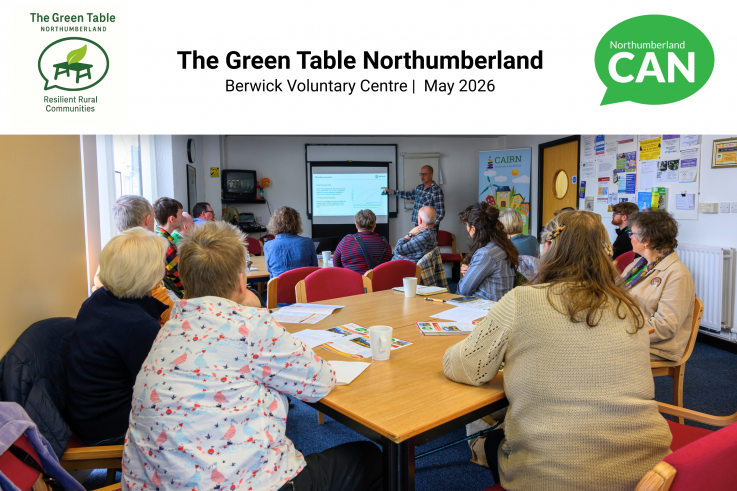
Community Action Northumberland hosted the third Green Table Northumberland event in Berwick-upon-Tweed last week, bringing together organisations, community groups and sustainability advocates from across the county to share ideas, strengthen partnerships, explore potential funding opportunities and implement practical action on climate change and renewable energy. The event was hosted by North Northumberland Voluntary Forum with an incredible buffet lunch provided by Coast to Country Catering.
The Green Table Northumberland is a growing network of roundtable events designed to connect organisations and community groups working to advance renewable technologies, carbon reduction measures and environmental action. The initiative creates space for collaboration, knowledge-sharing and practical discussion around the challenges and opportunities facing rural communities as they work towards a lower-carbon future.
The Berwick event welcomed 22 attendees representing a wide range of organisations and projects including Reheat, Community First Yorkshire, the National Innovation Centre for Rural Enterprise (NICRE), Groundwork North East & Cumbria, Greener Berwick, Northumberland Community Energy Limited (NCEL), Rothbury Climate Action and Nature, Rural Design Centre, Berwick Town Council, Berwick Parish Church, Karbon Homes and Asda Community Champion.
Opening the event, Andrew Beresford, Climate Action Officer from Community Action Northumberland, welcomed participants and reflected on the wider purpose of the Green Table series.
“The Green Table is a platform for us to focus on the ‘Green Agenda’: it is not just about energy, it’s about sustainability, green spaces and creating stronger communities,” he explained.
Andrew also highlighted the importance of bringing people together to share ideas and develop practical solutions for rural communities.
“This event is about networking, collaboration and practical action for greener communities. It is an opportunity to start conversations, share ideas and connect with new people. We want people to leave inspired.”
This event was particularly focused around “collaboration”. It encouraged attendees to build new connections, exchange knowledge and explore opportunities for future partnership working across Northumberland’s growing climate action network.
The first presentation came from Neil Harrison, Director of Reheat, an environmental specialist in renewable heat and decarbonisation projects. Neil described Reheat as “unashamedly rural” and “unashamedly independent”, reflecting the organisation’s strong focus on delivering renewable heat solutions for rural communities.
Drawing on his experience delivering projects across the UK, Neil explored the challenges of decarbonising heat in rural communities and the barriers currently slowing progress.
Speaking about fossil fuels, Neil warned that communities are currently “riding the rollercoaster of fossil fuels” because of instability in global energy markets. He also highlighted the social impact of rising heating costs in rural areas, sharing examples of fuel poverty, unsafe heating practices and wider health issues linked to cold homes, damp and mould.
Highlighting the scale of the challenge, Neil explained that “one third of our CO2 emissions comes from heat” while the UK is still installing “1.3 to 1.8 million gas boilers every year” compared to around “20,000 heat pumps per year”.
Neil stressed the particular difficulties facing rural communities, saying: “policy is not designed to decarbonise rural houses.”
Despite these challenges, Neil’s presentation focused strongly on the importance of cooperation and community-led approaches. He shared examples of collective heat initiatives and community energy projects from across Scotland, including communal heat networks and collective purchasing models designed to reduce costs and improve resilience.
Discussing the economic opportunity for rural areas, Neil highlighted that billions of pounds leave rural economies each year through fossil fuel spending and asked: “What could we do with that money instead?”
Neil also described rural heat decarbonisation as “the lowest hanging fruit and the most pressing place where we should be taking action, from an economic, carbon and social perspective.”
When asked what communities could do next, Neil’s response was simple: “Organise. Educate yourself. Lobby politicians.”
Concluding his presentation, Neil emphasised the importance of collaboration and local energy solutions, saying: “there is real opportunity there to create value, create jobs and decarbonise at the same time.”
The second presentation came from Charles Foreman, Climate Action Project Manager at Community First Yorkshire, who shared insights from the Village Green project, a large-scale climate action partnership funded through the National Lottery and combined authority support.
Drawing on his background in environmental partnership work, Charles reflected on the importance of collaboration in delivering successful community climate initiatives.
“Different partners bring different things to the table,” he explained, describing how community knowledge, volunteers, public bodies and environmental organisations all contribute different strengths to local projects.
Charles shared examples from previous environmental projects where community groups brought local knowledge, passion and trusted relationships, while larger organisations could provide funding, technical expertise and influence.
“It can be quite a lonely, scary place” working in small organisations, he said, highlighting the importance of building strong partnerships and support networks across the sector.
The Village Green project supports climate action projects across Yorkshire and focuses on four key themes: reducing carbon footprints, empowering young people, improving community green spaces and using creativity and community activities to engage people in climate action.
Charles explained that the project works with a wide range of audiences and communities, delivering activities “from young farmers to WI” groups and creating opportunities for people to engage with sustainability in practical and accessible ways.
One example is the project’s “Sustainability Showdown”, a quiz-style engagement activity designed to spark discussion around climate and sustainability topics in a positive and approachable way.
“It was a really good way of getting engagement,” Charles said, reflecting on a recent event where participants were highly engaged and open to discussion.
He also stressed the importance of patience and long-term thinking in community climate work.
“It might be a year down the line. It might be five years,” he said. “We don’t necessarily know how much an event impacts on people.”
Charles highlighted that many communities are motivated not only by environmental concerns, but also by practical issues such as energy prices and fuel security.
“People are interested in fuel security and fuel prices, as well as climate action,” he explained.
Discussing the project’s wider approach, Charles emphasised that the programme is designed around community priorities, rather than imposing solutions from outside.
“We are very much talking to communities about what they’re interested in and what they’re trying to do, but perhaps need support from us,” he said. “It’s a collaborative process.”
Charles also thanked Community Action Northumberland for its support and knowledge-sharing throughout the development of the project, particularly around energy audits, carbon calculators and project delivery.
“Collaboration is so important,” he concluded.
Attendees also heard from Belinda Fairbairn from NICRE, who discussed the role of collaborative problem-solving through “Climathon” events that bring stakeholders together to develop practical climate solutions through shared discussion and innovation.
The presentations set the tone for collaborative discussions that followed and continued into lunch, giving participants the opportunity to exchange ideas, share experiences and explore opportunities for future partnerships.
Throughout the day, discussions reinforced the importance of collaboration, knowledge-sharing and harnessing the passion and expertise that already exists within local communities to drive practical environmental action across rural Northumberland and beyond. Attendees were encouraged to continue building connections, sharing opportunities and working together between Green Table events to strengthen community-led approaches to sustainability, climate action and renewable energy.
Further Green Table Northumberland events will be announced soon. If your organisation or community group is interested in joining the discussion and becoming part of Northumberland’s growing network of groups working towards a greener future, please get in touch with the CAN Energy Team at energy@ca-north.org.uk
The Green Table Northumberland is facilitated by Climate Action in Rural North East (CAIRN). A partnership between Community Action Northumberland, Durham Community Action (DCA), the Rural Design Centre (RDC) and the National Innovation Centre for Rural Enterprise (NICRE), the project is funded by the National Lottery Community Fund.